
What Is a Bitcoin UTXO? Understanding How Bitcoin Really Moves
Discover how Bitcoin UTXOs work, how transactions create change, and why understanding unspent outputs matters for fees, privacy, and self-custody.

NodeAxe Learning Library | Bitcoin Fundamentals | Beginner Level
When you open a Bitcoin wallet, you see a balance. Maybe it’s 0.01 BTC, 0.05 BTC, or just a few thousand satoshis.
But here’s something surprising: Bitcoin doesn’t actually work like a traditional bank account.
Instead of maintaining individual account balances, Bitcoin tracks pieces of spendable value called UTXOs — Unspent Transaction Outputs.
Understanding UTXOs helps explain how Bitcoin transactions work, why transaction fees vary, and why managing your own wallet matters.
What You’ll Learn
By the end of this lesson, you’ll understand:
- What a UTXO is and how it is created.
- How Bitcoin transactions use inputs and outputs.
- Why Bitcoin wallets sometimes create change addresses.
- How UTXOs affect transaction fees and privacy.
- How to explore a Bitcoin transaction yourself.
1. What Exactly Is a UTXO?
UTXO stands for Unspent Transaction Output.
Whenever a Bitcoin transaction creates an output, that output represents an amount of bitcoin with specific conditions that must be satisfied before it can be spent.
Until it is spent, it remains a UTXO.
Think of UTXOs like individual bills in your physical wallet.
You might have:
- One $20 bill
- Two $10 bills
- One $5 bill
Your wallet contains $45, but that value exists as four separate bills.
Bitcoin works similarly, except the individual amounts are digital transaction outputs.
Your Bitcoin wallet calculates your available balance by adding together the UTXOs it can spend.
2. How Bitcoin Transactions Work
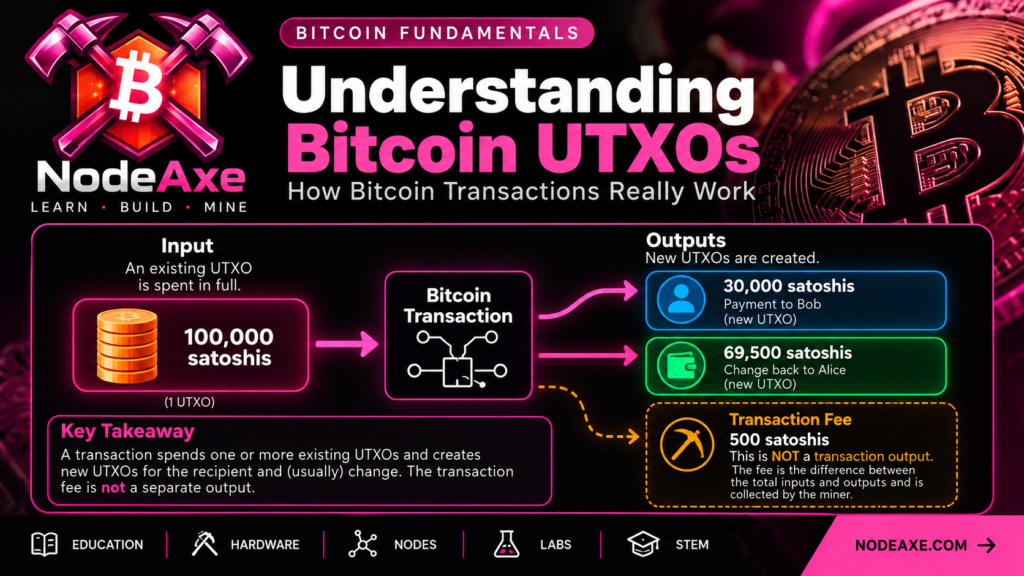
Imagine Alice has a UTXO worth 100,000 satoshis.
She wants to send Bob 30,000 satoshis.
A Bitcoin transaction typically spends the entire selected UTXO and creates new outputs.
Here’s a simplified example:
| Transaction component | Amount |
|---|---|
| Input: Alice’s existing UTXO | 100,000 sats |
| Output: Payment to Bob | 30,000 sats |
| Output: Change back to Alice | 69,500 sats |
| Mining transaction fee | 500 sats |
Alice’s original 100,000-satoshi UTXO is now spent.
The transaction creates two new outputs: one for Bob and one returning change to Alice.
The 500-satoshi difference is the transaction fee.
Important: The original UTXO is not partially spent. It is consumed entirely, and new outputs replace it.
3. Why Does Bitcoin Send Change Back to You?
Imagine paying for a $7 item using a $20 bill.
You hand over the entire bill and receive $13 in change.
Bitcoin follows a similar principle.
When your wallet selects a UTXO larger than the payment amount, it normally creates a change output returning the remaining bitcoin to a destination controlled by your wallet.
Modern wallets commonly generate a fresh change address automatically.
That means a Bitcoin transaction can have multiple outputs even when you’re paying only one person.
4. Why UTXOs Matter for Transaction Fees
Bitcoin transaction fees are primarily related to the amount of block space a transaction uses, not the dollar value being transferred.
A transaction combining many small UTXOs generally requires more input data than one spending a single UTXO.
For example, paying with ten separate small UTXOs may cost more in transaction fees than paying the same amount with one sufficiently large UTXO, assuming comparable script types and fee rates.
This is one reason advanced Bitcoin users pay attention to coin selection and UTXO management.
5. UTXOs and Bitcoin Privacy
Bitcoin transactions are recorded on a public blockchain.
When multiple UTXOs are spent together, blockchain observers may infer relationships between their controlling parties.
Change outputs can also provide clues about which bitcoin remains under the sender’s control.
These inferences are not always correct, but they illustrate why wallet behavior matters for financial privacy.
Understanding UTXOs is an important foundation for learning about self-custody, address reuse, coin control, and Bitcoin privacy.
6. Try It Yourself: Explore a Bitcoin Transaction
You can explore UTXOs without spending any bitcoin.
- Visit a public Bitcoin blockchain explorer, such as mempool.space.
- Open a confirmed Bitcoin transaction.
- Identify its inputs and outputs.
- Compare the total input value with the total output value.
- Observe the transaction fee.
Ask yourself:
- How many previous outputs were spent?
- How many new outputs were created?
- Can you identify a possible change output?
- Why might it be difficult to know which output is change?
Remember: A blockchain explorer shows public transaction information, but it cannot always reliably identify the real-world owner of an address or output.
7. STEM Classroom Activity: Build a Paper UTXO Wallet
Objective: Demonstrate how Bitcoin uses inputs, outputs, and transaction fees.
Materials: Paper, pencil, calculator, and small cards representing UTXOs.
Give each student three cards:
- UTXO A: 50,000 sats
- UTXO B: 30,000 sats
- UTXO C: 20,000 sats
Their wallet has a total balance of 100,000 satoshis.
Now ask them to send 60,000 sats with a fee of 1,000 sats.
One possible solution is to spend UTXOs A and B, totaling 80,000 sats.
They create:
- Recipient output: 60,000 sats
- Change output: 19,000 sats
- Transaction fee: 1,000 sats
UTXO C remains unspent at 20,000 sats.
The wallet now controls 39,000 sats across two UTXOs.
Discussion question: What would change if the student had twenty small UTXOs instead of three larger ones?
8. Key Takeaways
- Bitcoin tracks unspent transaction outputs rather than conventional account balances.
- A wallet balance represents the total value of UTXOs the wallet can spend.
- Spending a UTXO consumes the entire output.
- Transactions create new outputs for recipients and, commonly, change.
- UTXO selection influences transaction size, fees, and privacy.
- Understanding UTXOs helps you make more informed self-custody decisions.
Continue Learning With NodeAxe
Understanding UTXOs is the first step toward understanding how Bitcoin transactions work. But how do you protect the keys that authorize those transactions?
Explore our Beginner’s Guide to Building a SeedSigner to learn how offline Bitcoin signing works, or read Can You Create a Bitcoin Wallet With Dice? to discover how cryptographic randomness protects your wallet.
Related lessons planned for the NodeAxe Learning Library:
- How Bitcoin Transactions Work
- Bitcoin Wallets, Private Keys & Self-Custody
- Understanding Bitcoin Transaction Fees
- What Does a Bitcoin Full Node Actually Do?
- Bitcoin Privacy and Coin Control
These lessons will build on the concepts introduced here.
External Resources & Further Reading
For readers who want to explore the technical details:
- Bitcoin Developer Guide — Transactions
- Bitcoin Developer Guide — Blockchain
- Bitcoin Optech — Coin Selection
- Mempool.space — Bitcoin Blockchain Explorer
These independent resources provide additional technical explanations and tools for further study.
Keep Learning. Keep Building.
NodeAxe explores Bitcoin through hands-on education, open-source mining hardware, self-hosted infrastructure, security, and STEM projects.
Explore more educational resources through the NodeAxe Learning Library and follow our development updates through the NodeAxe community newsletter.